Welcome to Year 5 of COVID. 4 years since the first case. 3 years since the first vax. 2 years since Paxlovid. Nothing since then. You went back to work. That was the whole point. People resumed producing & consuming. Governments instantly stopped caring.
@DecorumManager

The current approach to Covid management is to not do any managing. The “strategy” is to ignore Covid by providing almost no official information about it, nor any protections against it, beyond the occasional vaccine booster. People mostly no longer think about it, and certainly don’t do anything to try to prevent it. They just leave it all to chance. They’ve totally bought the narrative that there’s nothing we can do, and that Covid is no big deal anymore anyway.
Yes, some things are better now
Just to stave off the accusations of Doomerism, I will note that, of course, in some ways, the situation has improved since the early years of the pandemic:
- We have vaccines that are quite effective at reducing hospitalization and death rates, and somewhat helpful at reducing rates of Long Covid.
- We have more options for treating acute Covid: Paxlovid, metformin, antihistamines, and so on. Some of these also reduce the risk of Long Covid.
- Long Covid is much more widely recognized by the medical establishment and society at large as a real and sometimes debilitating condition. Many studies are underway to learn more and find treatments.
Ergo, there is in fact no need to bring back the most stringent and onerous of Covid mitigations deemed necessary in 2020. Business shutdowns, travel restrictions, social gathering limitations and school closures weren’t great and aren’t necessary now.
But we’re doing nothing. Providing no protection to anyone, anywhere, ever basically. I believe this is a problem. Still.
Covid is rampant
All protections were dropped around March 2022, and since then, we’ve come nowhere near the low levels we achieved when we were trying to prevent the spread. I’m first drafting this at apoint where we’re pretty near the worst levels of infection we’ve ever had…
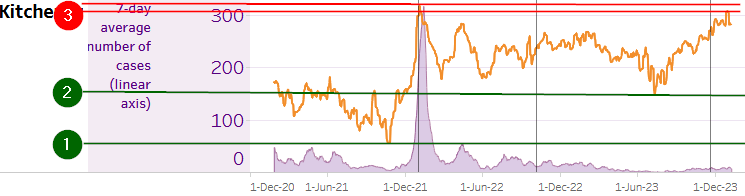
1 – Low point (October 2021).
2 – Lowest achieved since March 2022; note that it’s rather close to the high points in 2020/21.
3 – Current near-record high levels.
Note also throughout 2022, the deadliest year of the pandemic so far, even the lowest points were higher than earlier peaks…
Covid remains a serious disease. Having nearly the entire population infected with it at least once and at continual risk of being reinfected is not ideal!
On an individual level…
- Acute Covid infections can be very unpleasant and of fairly long duration. Some people still get sick enough with it to require hospitalization.
- Every infection brings with it a risk of Long Covid, an incurable condition. Severity varies, but at its worst, Long Covid is completely debilitating. Some victims of it improve with time, but many have not. While data says that the percentage of infected people who end up with Long Covid is lower now than in past years, the total number of people affected by it is nevertheless higher, because almost everyone catches Covid.
- Each Covid infection increases the risk of suffering from a host of other conditions afterwards, including heart attacks, stroke, blood clots, kidney disease, dementia, diabetes, mental illness, tinnitus, and immune dysfunction.
- “Hybrid immunity”—the decreased likelihood of catching Covid again after an infection— doesn’t always last that long, partly because the virus mutates so much. Some studies have even found an increased likelihood of reinfection, possibly due to immune system damage. Meaning there’s little upside to an infection.
- It’s a new virus. We simply do not know what the long-term effects of it are. Only that it does persist in the body.
- Covid still kills a lot of people. More than any other infectious disease, more than any single type of cancer.
On a social level…
- Economocally, workers regularly becoming sick and disabled year after year is not great for productivity. Unexpectedly having to replace key employees can cost businesses time and money.
- Healthcare systems already near collapse are further stressed. The system not has to treat people with complications from Covid itself, but also those who then suffer all of its more serious after effects.
- Social inequities are heightened. The risks of getting infected or reinfected with Covid are greatest among lower-income people, racialized people, and the disabled. And women are more at risk of Long Covid then men.
- The approach is discriminatory and ableist. The “vulnerable”, who have higher risk of poor outcomes from Covid infections, have the entire burden of trying to protect themselves with no help whatsoever from the rest of society. If they catch Covid at a concert, museum, or restaurant, it’s their fault for going there at all. They aren’t supposed to do anything enjoyable or fun with crowds of other people, ever again.
If they catch Covid on the bus, at their place of employment, at their medical appointments—still their fault. Even though they have no choice to go there, and even though, for something like a medical appointment, they might have no ability to protect themselves. It’s still up to them alone to try stay alive with no help from anyone else, not even medical personnel whose job is to do that very thing. It’s insane! - Covid continues to flourish and mutate, always with the possibility that one of the mutations could result in a variant that is more deadly and disabling than the ones we’ve encountered so far.
But what can we possibly do?
I’m glad you asked! We can start with:
- Providing real support for people staying home when sick.
- Improving indoor air quality.
- Gathering more data about the current state of SARS-Cov2 infection and sharing it more widely, more regularly.
- Providing better and more and more honest vaccine information, and funding research into better vaccines.
- Promoting and encouraging masking.
- Conducting public health campaigns to better educate the public about the nature of the virus and how to protect themselves and others from it.
- Studying and sharing information about other potential protections such as nose sprays, nose filters, mouthwash, probiotics, antihistamines, and supplements.
- Truly prioritizing the prevention of hospital-acquired Covid infections—starting with permanent mask mandates.
- Develop treatments for Long Covid.
- Making Covid part of the remote work / hybrid / in-office conversation.
- Increase Paxlovid usage.
Yep, it’s a list of mostly stuff that government needs to do (with a side of stuff that business needs to do) and nope, there isn’t much political (or corporate) appetite for it. But, it’s still the type of thing that needs to be done. So, I will try to expand on each idea, covering:
- How this would be helpful
- Side benefits: What other problems this helps solves
- Why it isn’t happening now (or not enough)
- What an individual can do to try to make it happen
 Cultureguru Archive